
Understanding AI Search: How to Rank Your Ministry in 2026
A comprehensive look at the core factors to set your ministry up for optimal growth and visibility—both in AI search platforms and traditional search engines.
Ryan Tims
12/10/2025
How can you increase your Church’s chances of being mentioned by AI search assistants like ChatGPT while simultaneously ranking higher in traditional search engines like Google? Great question!
I’ve spent years helping organizations navigate the digital world, and having also served as a pastor, I genuinely love teaching churches how to use these tools to thrive.
So, let’s dive right into the foundation of how AI search engines operate.
The Foundation: How AI Search Engines ‘See’ Your Church
Understanding how traditional search engines evaluate content will help you rank better—not just on Google and Bing, but across the new generation of AI-driven search tools as well.
All search engines have one primary goal: to satisfy a person’s search intent.
In simple terms, they want to give people exactly what they’re searching for. If you find what you need on Google (or any other search platform), you’re far more likely to come back—and search engines know this. Their entire business depends on meeting searchers' needs consistently.
AI search engines (AI assistants, chatbots, generative engines, LLM’s, or whatever new term is created tomorrow) like ChatGPT, Gemini, and Perplexity operate differently on the technical level than Google—but they tend to reward the same signals when deciding what information to surface.
Unlike Google, AI assistants don’t “crawl the live internet” in real time, but they are trained on public web content (in addition to licensed data and human feedback). Because that training reflects what performs well online, AI models naturally prioritize authoritative, well-structured, widely linked, and clearly described content—the same qualities traditional search engines reward.
So, while Bing and ChatGPT use different systems, Chat uses Bing’s data. And because they both want to make people happy, they rely on many of the same core indicators of trust, relevance, and authority. This is why the ministries that show up on Bing and Google for “best churches in ___” or “churches near me” are often the same ones AI engines mention when asked similar questions.
So, without further ado, let’s look at exactly what these core factors are so you can practically set your ministry up for optimal growth and visibility—both in AI search platforms and traditional search engines.
THE FOUR CORE RANKING FACTORS FOR ALL SEARCH PLATFORMS
Ever wonder how Google decides which website to show first? Below is an unofficial (and simplified) list that helps you conceptualize how search engines—and even modern AI-driven platforms—evaluate and rank websites. We’ll break each of these down in detail. These are not listed in order of importance:
Website Health & User Experience
Content Relevance & Quality
Backlinks & Authority
Public Reputation Signals
Let’s look at each one individually.
1. Website Health and User Experience
Search engines know that no one wants to be hacked, wait five seconds for a page to load, or land on a website where the text is microscopic or shoved to one side of the screen. Because they want to keep people happy (and coming back), website health and user experience are major ranking factors for both traditional and AI-driven platforms. To evaluate your website’s health and user experience, ask yourself these questions:
Is your website safe?
Most modern websites already use HTTPS, but double-check—especially if your site is older. If any of your URLs start with http:// instead of https://, fix it right away.
Is your website fast?
Speed matters. A slow website frustrates people and lowers your chance of ranking well.
Aim for a file size under 1MB for all images on your site.
For a free speed audit, visit https://pagespeed.web.dev and enter your domain. You’ll see exactly what’s slowing things down.
Is your website mobile-friendly?
Google expects every modern website to work flawlessly on mobile devices. Many people visit church websites exclusively on their phones. If your site looks perfect on a desktop but terrible on mobile, Google will notice—and penalize the experience accordingly.
Most current website builders include responsive design automatically, but older sites may not. If text is tiny, broken, or drifting off the page on a phone, it’s time for an upgrade.
Is your website cluttered?
Don’t cram 1,000 words into one paragraph or display ten different ideas on the screen at once. The best websites present one main message per section (“per fold”).
A great example is the Christ Church website: each section highlights a single idea with a clear headline and supporting text. This helps people process information instead of mentally checking out.
2. CONTENT RELEVANCE AND QUALITY
This factor addresses two big questions:
Does your church clearly exist in a specific place?
Do your pages clearly communicate what they’re about?
Relevance: Google Business Profile
For a church, “relevance” doesn’t mean trendiness—it means evidence that your ministry exists in a real geographical community.
The number one way Google determines this is through your Google Business Profile.
Creating and verifying a Google Business Profile is the single most important action you can take to appear in local searches like:
“Churches near me”
“Bible believing churches in ___”
“Youth ministry in ___”
It helps you show up in the map pack, provides immediate contact info, and allows people to leave Google reviews (we’ll talk about reviews later under public reputation).
If you want people to find your ministry in local searches, you must have a Google Business Profile. It is the foundation of local digital relevance.
Quality: Keyword Content
Once Google (or an AI model) knows your church exists in a location, it needs to figure out what kind of church you are and what each page on your site is about.
This is where keywords come in.
One of the simplest and most effective ways to improve your visibility for search engines is understand the top 3 places search engines look to determine what your page is about:
H1 heading (the visible on-page title - should be only one per page)
Meta title (the blue link title in search results)
Meta description (the short snippet under that title)
Search engines look at these three content areas to determine what your page is about.
Think of it like a book in a store:
The meta-title is the title on the cover.
The meta-description is the subheading on the cover or the summary on the back.
The H1 is the title shown inside the book.
If someone searches for “traditional worship service in Phoenix,” search engines check:
Does the H1 mention “traditional worship” or “Phoenix”?
Does the meta title mention that?
Does the meta description support it?
Does the on-page content line up with that description?
If your metadata and content are vague or mis-aligned, you decrease your chances of appearing for those searches. But if you have high-quality, descriptive content, then you will provide plenty of keyword-rich terms for engines to work with.
A Church Metadata Example
Weak setup (very common):
H1: Trinity Church
Meta Title: Church – Home
Meta Description: Celebrate with us Sundays at 10am.
Nothing here provides any keyword-descriptive information.
Stronger setup:
H1: Traditional Worship & Biblical Teaching – Trinity Church Phoenix
Meta Title: Traditional Worship & Biblical Teaching | Trinity Church
Meta Description: At Trinity Church Phoenix, we value traditional worship services with hymns and verse-by-verse Bible teaching. Celebrate with us!
Now, if someone searches for “traditional worship phoenix” or “bible teaching church phoenix,” search engines have something concrete to work with.
You don’t have to be a professional copywriter. You simply must describe your church accurately, honestly, and thoroughly—and make sure your H1, meta title, and meta description support that description instead of hiding it.
Any essential keyword that you want to be “found” for should exist in all three of these locations—as well as on the page. Extra points if you include the keyword in any image alt text or in your URL.
Let’s look at an example to help us all understand what the meta title and meta description actually are by picking on a couple of church management software companies.
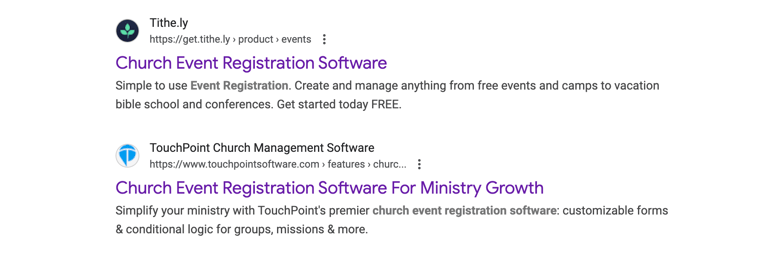
When you do a google search for “church event registration software” you can see Tithely and TouchPoint Software showing up in the top results on the SERP (search engine results page).
In search results like this, the largest text you see for a listing is the meta-title for that page, and the smaller subtext below it is the meta-description. In the case of TouchPoint's result, the meta-title is "Church Event Registration Software For Ministry Growth," and Tithely’s is “Church Event Registration Software.”
I like that TouchPoint uses the exact keyword phrase in the title while also adding “For Ministry Growth” as it adds their why behind the what, also providing more keyword information to be used by search engines.
You can see in the meta description (smaller text below the titles) that TouchPoint uses the exact-match keyword phrase again in the description and Tithely decided to use a shortened variation with “Simple to use Event Registration.”
The best SEO results come when the same keyword, or description, appears in all three areas—as well as on the actual webpage within high quality content.
SEO is simple when you strip away the jargon:
Tell search engines exactly who you are, and they can show you to the right people.
Now that we’ve covered relevance and quality, we need to look at the second major factor that influences your ministry’s visibility online: your website’s authority.
3. BACKLINKS & DOMAIN AUTHORITY
Backlinks are links from other websites to yours. They act like digital street credibility, and they are one of the most powerful ranking factors.
If a website has many relevant, trustworthy links pointing to it, search engines see it as more authoritative.
If a website has almost no links pointing to it, common sense says that it is not a trusted authority.
Some big websites (like Amazon) score very high on domain authority (they have a 96 on the 0-100 scale) because millions of sites link to them. A brand-new website starts at 0/100 and grows as more sites link to it.
For churches, backlinks provide an incredible opportunity for online growth, because the nature of ministry is to connect with your community. As a church you will likely connect naturally with:
partner ministries
missionary organizations
other churches you collaborate with
local nonprofits and businesses you serve alongside
local news organizations
When those relationships turn into links (for example, on a “Partners,” “About,” or “Our Church Family” page), search engines and AI platforms see that your ministry is connected, trusted, and active.
We’ll go into deeper tactics on backlinks and domain authority another time, but for now, just remember: search engines and AI assistants strongly favor ministries that other trustworthy sites are willing to link to.
4. PUBLIC REPUTATION SIGNALS — Reviews, Ratings, and Prominence
Public reputation signals are the ways people talk about your ministry online:
reviews
ratings
comments/mentions
Search engines and AI platforms pay attention to these because they want to recommend ministries that are trusted and helpful. Traditional search engines focus more on tangible reviews and ratings, but AI platforms actively take into account social media and activity on platforms like Reddit.
Reviews & Ratings
Google Reviews are particularly important. Google has directly stated that reviews on your Google Business Profile are an important factor in local rankings.
If people love your ministry, invite them to share their experience on Google. Reviews:
add helpful, descriptive content to your listing
show real community engagement
reinforce your church’s identity (“welcoming,” “solid teaching,” “great kids ministry,” etc.)
If someone leaves a negative review, respond with grace and honesty. Your response matters as much as the review itself. AI engines consider the tone and content of your replies.
Prominence: Your Overall Online Footprint
Prominence is basically your overall visibility and activity across the internet.
This includes:
your website
your Google Business Profile
social platforms (Facebook, Instagram, YouTube, TikTok, LinkedIn)
mentions in community sites or blogs and forums
denominational listings or ministry directories
So, if a church has these, search engines can confidently say, “This ministry has proven importance and relevance.”
If you have thriving social media accounts but never link them to your website (and never link your website back to them), AI engines and Google may not realize they’re all talking about the same church.
Make it easy for search engines by linking all relevant accounts.
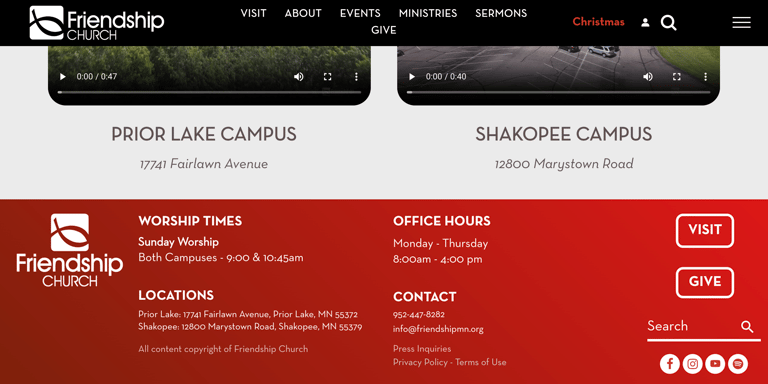
Linking from your church website can be as subtle as simple button links in the bottom of your footer as shown here on Friendship Church’s website.
A simple set of links among your website, Google Business Profile, and social accounts help search tools see the full picture of your ministry’s presence.
A Real-World Example:
“Bible Believing Churches in My Area”
Let’s put this together in a simplified scenario.
Someone searches for: “bible believing churches in my area.”
Here’s the kind of logic search engines and AI tools use:
Who is actually local?
They check Google Business Profiles and address info to see which churches are physically near the searcher.
Who is clearly relevant?
They look at these church’s websites to see which include phrases like “bible-believing,” or “believe in the bible,” or similar language in their H1s, meta titles, meta descriptions, and content.
Who seems most authoritative?
Among those churches, they favor the ones with more solid backlinks and a stronger overall web presence.
Who provides the best website experience?
They check for secure HTTPS, fast load times, mobile-friendly design, and clear structure.
Who is most trusted by people?
They weigh Google reviews, review sentiment, and other public mentions.
Additionally, AI engines will strongly consider blog mentions, forums like reddit, and social media. Traditional search engines do not consider these in the same way as AI platforms.
The “winner” isn’t necessarily the biggest church. It’s the church that best matches the searcher’s intent and shows strong signals of clarity, authority, and trust across these four factors.
BRINGING IT HOME
The digital world, in many ways, is built on simple, common-sense principles that mirror real ministry:
Your ministry should be a safe place for people.
→ A secure HTTPS website reflects this.
Your ministry should utilize clear and effective communication.
→ SEO-rich, descriptive language helps people understand who you are and what you do.
Your ministry should be connected to the body of Christ.
→ Backlinks reflect real relationships with other ministries and partners.
You should make it easy for people to come to you and invite feedback.
→ A Google Business Profile and the reviews that come with it do exactly that.
You should meet people where they are.
→ A simple social media presence and a connected online footprint give people more opportunities to encounter your ministry.
In summary, growing your ministry’s presence with search engines and AI platforms is ultimately based on common sense.
At the core, these systems reward clarity, trust, connection, and real-world presence—the same values that matter in real ministry.
And last, but certainly not least: true growth comes from Jesus.
He builds His church. Our idea of church growth is not always His—in fact, it’s often much different from His.
“Unless the Lord builds the house, the workers labor in vain.” (Psalm 127:1)
Everything in this blog is meant to help you use the tools available to you, not as a means to chase numbers, but to reach people you can help. Church growth becomes an idol when we make metrics the goal instead of loving and following Jesus.
True discipleship happens when we learn to receive His love without constraint—and then love others the same way.
I pray these tools simply help you open the doors a little wider, so the people who need your ministry can find you.