
5 Key Factors to Rank Your Church in AI Search (2026 Guide for Ministries)
Barzel Solutions
How can you increase your Church’s chances of being mentioned by AI search assistants like ChatGPT and rank higher in traditional search engines like Google? Great question!
I work with ministries and businesses every day doing exactly that—helping them grow their online presence by making the various platforms work in their favor. (Bonus: I also pastored for years, so I’m deeply passionate about helping ministries thrive!)
So without further ado, let’s look at exactly what you can do to practically set your ministry up for optimal growth and visibility—both in AI search platforms and traditional search engines.
To set the stage, here are the essential elements every ministry needs to succeed digitally in 2026:
Digital Success Checklist for 2026
A clean, secure, fast, mobile-friendly website
An active and verified Google Business Profile
SEO with rich descriptive language on your site
Backlinks from authoritative and relevant websites
Public Reputation Signals — reviews, ratings, and prominence
With these essentials in mind, let’s establish the foundation by understanding how both AI and traditional search engines evaluate and rank ministries.
THE FOUNDATION: UNDERSTANDING AI SEARCH ENGINES
AI search engines (AI assistants, chatbots, generative engines, large language models, etc.) like ChatGPT, Gemini, and Perplexity operate differently on the technical level than Google—but they tend to reward the same signals when deciding what information to surface.
Unlike Google, AI assistants do not “crawl the live internet” in real time. Instead, they are trained on vast amounts of publicly available web content, along with licensed data and human feedback. Because that training data reflects what performs well on the open web, AI models naturally prioritize authoritative, well-structured, widely linked, and well-described content—the same qualities traditional search engines like Google and Bing reward.
So while Google and AI platforms use different systems, they still rely on many of the same core indicators of trust, relevance, and authority. This is why the ministries that show up on Google for “best churches in ___” or “churches near me” are often the same ones AI engines mention when asked similar questions.
Understanding how traditional search engines evaluate content will therefore help you rank better—not just on Google and Bing, but across the new generation of AI-driven search tools as well.
Search engines have one primary goal: to satisfy a person’s search intent. In simple terms, they want to give people exactly what they’re looking for. If you find what you need on Google (or any other search platform), you’re far more likely to come back—and search engines know this. Their entire business depends on meeting searchers' needs consistently.
THE FOUR CORE RANKING FACTORS FOR ALL SEARCH PLATFORMS
Ever wonder how Google decides which websites to show first? Below is an unofficial (and definitely simplified) list that helps you conceptualize how Google—and even modern AI-driven platforms—evaluate and rank websites. We’ll break each of these down in detail. These are not listed in order of importance:
Website Health & User Experience
Content Relevance & Quality
Backlinks & Authority
Public Reputation Signals
Let’s look at each one individually.
Website Health and User Experience
Search engines know that no one wants to be hacked, and no one wants to wait five seconds for a page to load. They also know that if someone lands on a website where the text is microscopic or shoved to one side of the screen, that person will bounce immediately. Because search engines want to keep people happy (and coming back), website health and user experience are major ranking factors for both traditional and AI-driven platforms.
To evaluate your website’s health and user experience, ask yourself these questions:
Is your website safe?
Security matters to Google and every other search engine. They do not want to send people to insecure sites. If any of your URLs start with http:// instead of https://, fix it right away. This simply means you need an SSL/TLS certificate so the data between your site and your visitors is encrypted.Most modern websites already use HTTPS, but double-check—especially if your site is older.
Is your website fast?
Speed matters. A slow website frustrates people and lowers your chance of ranking well.
For a free speed audit, visit https://pagespeed.web.dev and enter your domain. You’ll see exactly what’s slowing things down. If the results look like a foreign language, screenshot them and ask ChatGPT or the nearest millennial in your congregation for help.
Bonus Hack:
Make sure your images are small. Aim for under 1MB. On a Mac, you can right-click an image → Quick Actions → Convert Image → choose Large or Medium. This preserves quality while dramatically shrinking the file size.Is your website cluttered?
Don’t cram 1,000 words into one paragraph or display ten different ideas on the screen at once. The best websites present one main message per section (“per fold”).
A great example is the TouchPoint Software website: each section highlights a single idea with a clear headline and supporting text. This helps people actually process the information instead of mentally checking out.Is your website mobile-friendly?
Google expects every modern website to work flawlessly on mobile devices. Many people visit church websites exclusively on their phones. If your site looks perfect on a desktop but terrible on mobile, Google will notice—and penalize the experience accordingly.Most current website builders include responsive design automatically, but older sites may not. If text is tiny, broken, or drifting off the page on a phone, it’s time for an upgrade.
If this already feels overwhelming…
Take a breath. You can build a fast, secure, mobile-friendly website using simple website builders like Hostinger, Wix, or Squarespace for just a few dollars a month. Keep your design clean and avoid unnecessary complexity. Don’t add user logins or custom systems until you truly need them. When it’s time to integrate more advanced features or connect your church management software platform, you can tackle that later.
For now, focus on building the simplest, clearest version of your website. That alone puts you ahead of many churches online.
CONTENT RELEVANCE AND QUALITY
Google — and effectively every modern search platform, including AI engines — evaluates websites using extremely advanced systems designed to understand content. One of Google’s key quality frameworks is E-E-A-T, which stands for Experience, Expertise, Authoritativeness, and Trustworthiness. These signals help search engines determine which content is credible, relevant, and useful.
Let’s break this down in a way that makes sense for church ministries.
RELEVANCE
For a church, “relevance” doesn’t mean trendiness — it means proof that your ministry actually exists in a real geographical community. The number one way Google determines this is through your Google Business Profile.
Creating and verifying a Google Business Profile is the single most important action you can take to appear in local searches. It helps you show up in the map pack, provides immediate contact info for seekers, and allows people to leave Google reviews — a ranking factor we’ll cover later.
If you want people to find your ministry in local searches, you must have a Google Business Profile. It is the foundation of digital relevance.QUALITY
Content quality for a ministry simply means this:
How clearly do you communicate who you are and what you do?
Clear, descriptive language helps both people and search engines understand your ministry’s identity, theology, style, and community presence.
You don’t need to be a professional copywriter. You just need to describe your church accurately, honestly, and thoroughly.THE SEO TRIO: H1, META TITLE, META DESCRIPTION
One of the simplest and most effective ways to improve your visibility is to optimize your page’s H1 heading, meta-title, and meta-description.
These three components are the primary text signals search engines rely on to understand what a page is about.
Think of your webpage like a book at a bookstore:The H1 is the title inside the book.
The meta-title is the title on the spine.
The meta-description is the short summary on the back cover.
Search engines read all three.
H1 Heading
The main headline visible at the top of your page.
Only one H1 per page.
Should clearly state what the page is about.
Meta-Title
Your SEO title in search results.
Aim for under 60 characters (ideal is ~55).
Often similar to the H1.
Meta-Description
The snippet below your meta-title in Google results.
Aim for under 160 characters (ideal is ~155).
Summarizes what the page offers.
Platforms like WordPress (with RankMath/Yoast), Webflow, Wix, or Hostinger all include places to easily edit metadata — you just have to know to look for them.
Let’s look at an example to help us all understand what the meta title and meta description actually are.
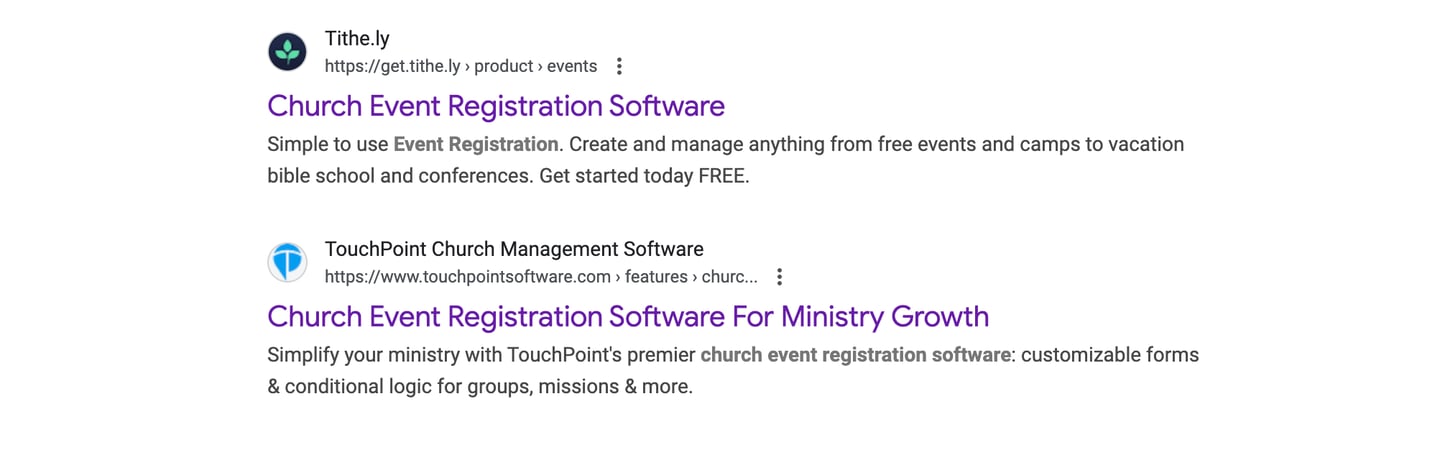
When you do a google search for “church event registration software” you can see Tithely and TouchPoint Software showing up in the top results on the SERP (search engine results page).
In search results like this, the largest text you see for a listing is the meta-title for that page, and the smaller subtext below it is the meta-description. In the case of TouchPoint's result, the meta title is "Church Even Registration Software For Ministry Growth," with the meta description directly below it.*Use our free character count calculator tool to optimize your titles and descriptions for the exact character length.
WHY CONSISTENCY MATTERS
Search engines compare what your metadata says your page is about with what your actual content shows.If someone searches “best wooden table legs,” Google checks:
Does the page talk about and/or sell actual wooden legs for DIY tables?
Does the H1 mention wooden table legs?
Does the meta-title mention wooden table legs?
Does the meta-description mention wooden table legs?
Search engines know that this searcher is looking to learn about or buy actual table legs, not some random website that makes table lamps in the shape of a leg like the infamous ugly lamp in A Christmas Story movie. So search engines will examine the on page content and compare it to the heading and metadata to see find a webpage like this one from Carolina Leg Co.
Bad Example (very common for churches):
Page H1 Title: Trinity Church
Meta-Title: Church – Home
Meta-Description: Celebrate with us Sundays at 10am.
Nothing descriptive. No theology. No denomination. No worship style. No location. No identity.
Google has nothing to match to real search queries.
Good Example:
Page H1 Title: Traditional Worship & Biblical Teaching - Trinity Church Phoenix
Meta-Title: Traditional Worship & Biblical Teaching | Trinity Church
Meta-Description: At Trinity Church Phoenix, we value traditional worship services with hymns and verse by verse bible teaching. Celebrate with us!
Now Google knows exactly who you are.
The best SEO results come when the same keyword, or description, appears in all three areas.
SEO is simple when you strip away the jargon:
Tell search engines exactly who you are, and they can show you to the right people.
Now that we’ve covered how to make your content relevant and high-quality, we need to look at the second major factor that influences your ministry’s visibility online: your website’s authority.
BACKLINKS & DOMAIN AUTHORITY
Backlinks are simply links from other websites to yours — and they are one of the strongest indicators of website authority.
Think of domain authority as your website’s “street credibility”. It’s measured on a scale from 0 to 100. Big, established websites like Amazon score in the high 90s because millions of websites link to them. A brand-new church website starts at 0 and increases as relevant, trustworthy sites link to it.
Do-Follow vs No-Follow Links
There are two types of backlinks:
Do-Follow → pass authority (“link juice”)
No-Follow → do not pass authority
If you’re ever mentioned in an article or directory, it’s perfectly okay to ask the publisher if the link to your church can be “do-follow.”
Relational Link Building (Churches’ Biggest Untapped Opportunity)
Churches build relationships every day with ministries, missionaries, nonprofits, community partners, and other churches. Turn those real-world relationships into digital backlinks.
Examples:
Link to ministries you partner with and have them link back
Feature missionaries you support and ask them to link your church
Exchange links with local nonprofits you serve alongside
Create a “Ministry Partners” page
Add links in your events or outreach write-ups
These backlinks tell search engines:
“This church is connected, active, and trusted by other organizations.”
And that builds authority.
Use Descriptive Link Text
Please, I beg you, avoid using vague link text like “click here.”
Instead, use either the actual ministry name or descriptive terms like:
Calvary Chapel Oceanside
college campus outreach in Atlanta
best food kitchen in Lexington
missionary partners in Guatemala
This helps search engines understand what the link represents. Non-descriptive link texts sends a poor link quality signal to search engines.
PUBLIC REPUTATION SIGNALS — Reviews, Ratings, and Prominence
Public reputation signals are simply the ways people talk about your ministry online. These include reviews, ratings, comments, mentions, and even the size and activity of your social media presence. Search engines and AI platforms pay close attention to these signals because they help determine which ministries are trusted, helpful, and active in their communities.
This is not something to get overwhelmed by. You don’t need perfect reviews or massive followings. You simply need to be present, be consistent, and treat people well — the same things you’re already doing.
Reviews & Ratings
Google Reviews (The Most Important Factor)
Google has directly stated that Google Business Profile reviews are a ranking factor. If you want to appear in local searches such as “churches near me,” your Google reviews play a significant role in determining where you show up.
If people love your ministry, invite them to share their experience on Google. Reviews add valuable content to your listing, show real community engagement, and strengthen your visibility.
And if someone leaves a negative review? Respond with grace. Your response matters just as much as the review itself. AI engines recognize tone, context, and sincerity — and they understand that every ministry will encounter a few unfair reviews.
Other Review Platforms (Secondary but Valuable)
Google reviews are the most impactful, but search engines also notice your presence on platforms like:
Yelp
Facebook reviews
Reddit threads
Local news articles or press mentions
Ministry listings or denominational directories
These don’t influence ranking as strongly as Google reviews, but they do contribute to your ministry’s overall “reputation profile” online. In simple terms: if people mention you, search engines notice.
Prominence (Your Overall Online Footprint)
Prominence refers to how visible, active, and connected your ministry appears across the internet. Search engines and AI assistants use prominence to verify that your church is a real, established entity.
This is where your social media accounts and external platforms come into play. Not because social media directly boosts rankings — it doesn’t — but because it helps platforms connect the dots.
If a church has:
A website
A Facebook page
An Instagram account
A YouTube channel with sermons
A TikTok or LinkedIn profile
Mentions in community sites or ministries
…search engines will recognize these as signals that your ministry is active, engaged, and well-connected.
Why linking matters
If you have a thriving Instagram, Facebook, or YouTube account with thousands of followers, but you never link them to your website (and never link your website back to them), then AI engines and Google may not realize those accounts belong to the same ministry.
A simple set of links between your website and your social platforms helps search engines see the full picture of your ministry’s prominence online
Bringing It All Together
Public reputation signals are simply the digital version of real-world reputation. If your ministry shows up with kindness, consistency, and presence in your community, the online world will reflect that.
Treat people well.
Encourage honest reviews.
Respond with grace.
Keep your ministry findable in the places people naturally look.
Search engines reward ministries with strong reputations because people reward ministries with strong reputations. It’s all common sense — just expressed in digital form.
TWO REAL WORLD EXAMPLES
Let’s take all of these factors and look at a couple of examples:
Example #1: “Bible believing churches in my area”
Let’s look at how a real search (whether on Google or an AI assistant) would evaluate ministries using the factors we’ve discussed.
A user types “bible believing churches in my area.”
The search engine now tries to identify the best possible match. So it quickly evaluates:
Actual churches near the searcher (Local Relevance)
It first determines which churches physically exist in the user’s geographical area.
This comes almost entirely from:Google Business Profiles
accurate address information
up-to-date contact details
If your church doesn’t have a Google Business Profile, you’re already invisible here.
Which local churches actually use the phrase “bible believing” (Content Relevance)
Next, the engine checks:H1 headings
meta titles
meta descriptions
homepage and “About” content
belief statements
location pages
It looks for clear matches to the phrase “bible believing.”
If Church #1 has that phrase on their site and Church #2 doesn’t, Church #1 is now in the lead.
Which matching churches have the strongest authority (Backlinks & Domain Strength)
Among churches that meet the searcher’s intent, Google evaluates which ones have:the most reputable backlinks
the strongest domain authority
the most online references
If multiple churches describe themselves as “bible believing,” the one with more backlinks typically ranks higher and wins the AI mention.
Which churches offer the best website experience (Health & UX)
Of the remaining contenders, Google gives preference to the churches with:secure HTTPS sites
fast load times
mobile-friendly pages
clear navigation and content structure
A safe, optimized site always gets an advantage.
Which churches have the strongest public reputation (Reviews & Ratings)
Finally, Google looks at real-world sentiment:Google reviews
review velocity (how often new reviews appear)
sentiment in reviews (“friendly,” “welcoming,” “biblical teaching”)
other public mentions (Yelp, Reddit, denominational directories)
If Church A has 3 reviews and Church B has 200 reviews with a 4.9 rating, Church B is highly favored.
Putting it all together
This is a simplified breakdown, but it shows the basic flow of logic. Search engines and AI search assistants all try to:
Identify who is actually local
Determine who is actually relevant
Prioritize who is most authoritative
Reward who is most user-friendly
Highlight who is best trusted
This is the heart of how traditional search engines and modern AI platforms surface recommendations.
Example #2: 4 Churches
Now imagine there are four Baptist churches in Loveland, Colorado, and all four have Google Business Profiles.
Church #1 has a huge congregation but a mediocre, outdated website.
Church #2 is another large church, but they’ve recently launched a brand-new, fully optimized website.
Church #3 is a brand-new small church plant, but they also have a shiny, fast, modern website.
Church #4 is the smallest church of all, maybe sixty members, with a website that looks like it still runs on dial-up and hasn’t been updated since before Y2K almost ended the world.
So… which church will Google rank #1?
Which one will ChatGPT recommend first?
The honest answer: we have no idea yet, because we haven’t looked at backlinks or reviews.
If none of these churches have backlinks or reviews…
Then the likely winner is Church #2, simply because:
It has an optimized website
AND a longer-standing domain than Church #3
Age + optimization wins that tie.
But once we add backlinks and reviews into the equation… everything changes.
Any of these churches could end up ranking #1 — even the smallest church with the worst website.
Take Church #4, for example. Let’s say this little church with the ancient website happens to have:
strong partnerships with ministries across the state
connections with churches around the world doing missions
a pastor who wrote a book featured by Focus on the Family and Christianity Today
annual community drives that get covered by local news sites
If any one of these things were true, Church #4 might have the strongest backlink profile of the group which means search engines could see them as the most authoritative and influential church in the area.
Suddenly, the little church with the dial-up-speed website might outrank everyone.
Or consider Church #3, the new church plant.
Imagine they’re the only ones using rich, descriptive SEO language in their metadata:
H1: “Thriving Baptist Church in Loveland”
Meta Title: “Thriving Baptist Church in Loveland | Contemporary Worship & Community”
Meta Description: “A thriving Baptist church in Loveland focused on biblical teaching, community, and local outreach.”
Suddenly, if someone searches: “thriving baptist church loveland”
Google looks at all four churches and says: “This one matches the intent exactly.”
Google isn’t trying to play favorites, it’s simply trying to satisfy the searcher’s intent.
So even though Church #3 is small and brand new, they might get the #1 spot.
And finally, look at Church #1.
Church #1 doesn’t have a great website and it barely has any backlinks.
But what if it does have something the others don’t: 1,000 five-star Google reviews because their large congregation actually took the time to write them.
Google and AI platforms pay serious attention to this.
Even if their website isn’t great, and even if they have fewer backlinks, a massive amount of overwhelmingly positive reviews sends a strong signal of trust, community engagement, and real-world prominence.
If everyone is saying this church is the best…Google just might agree.
BRINGING IT HOME
The digital world, in many ways, is built on simple, common-sense principles just like this. If you operate the online representation of your ministry the same way you operate your actual ministry, you will naturally meet, and likely exceed, the expectations of both traditional search engines and modern AI platforms.
Consider these digital factors through the lens of real ministry:
Your ministry should be a safe place for people.
→ A secure HTTPS website reflects this.Your ministry uses clear and effective communication.
→ Help people understand who you are and what you do with SEO-rich, descriptive language.Your ministry is connected to the body of Christ.
→ You don’t operate in isolation. Backlinks reflect real relationships with other ministries and partners.You make it easy for people to come to you and invite feedback.
→ A Google Business Profile — and the reviews that come with it — does exactly that.You meet people where they are.
→ Even a simple social media presence or occasional post gives people another place to encounter your ministry in their daily lives.
In summary, growing your ministry’s presence with search engines and AI platforms is ultimately based on common sense.
My goal in breaking this down is to help you see how simple it really is. Yes, we’re dealing with technology, and some details (SSL certificates, page-speed optimization) can sound intimidating — but even those can be solved with tools like ChatGPT and a tech-savvy young adult in your church.
The truth is, traditional search as we know it is shifting, and the age of AI is already here — whether we like it or not. But if you understand these fundamental concepts of how search engines operate, you’ll be equipped to thrive no matter how things evolve. At the core, these systems reward clarity, trust, connection, and real-world presence — the same values that matter in real ministry.
And last, but certainly not least: follow Jesus.
He builds His church. Our idea of church growth is not always His — in fact, it’s often much different from His.
“Unless the Lord builds the house, the workers labor in vain” (Psalm 127:1).
Everything in this blog is meant to help you use the tools available to you, not as a means to chase numbers, but to reach people you can help. Church growth becomes an idol when we make metrics the goal instead of loving and following Jesus. True discipleship happens when we learn to receive His love without constraint — and then love others the same way.
I pray these tools simply help you open the doors a little wider, so the people who need your ministry can find you.